Publications
Supple et al., (2022) Generating spatiotemporal patterns of linearly polarised light at high frame rates for insect vision. J. Exp. Biol. 225(13), JEB244087 https://doi.org/10.1242/jeb.244087
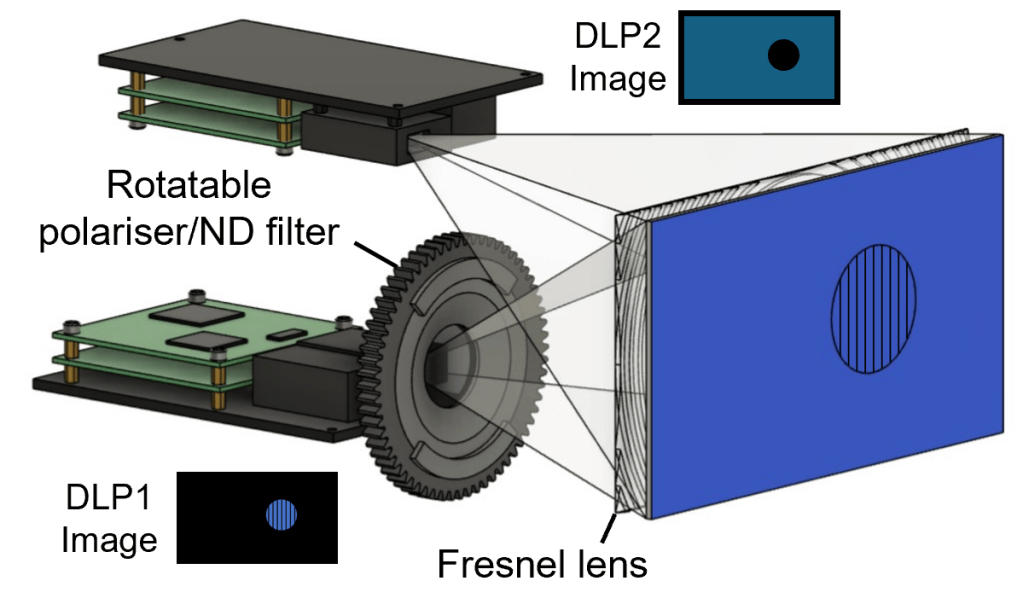
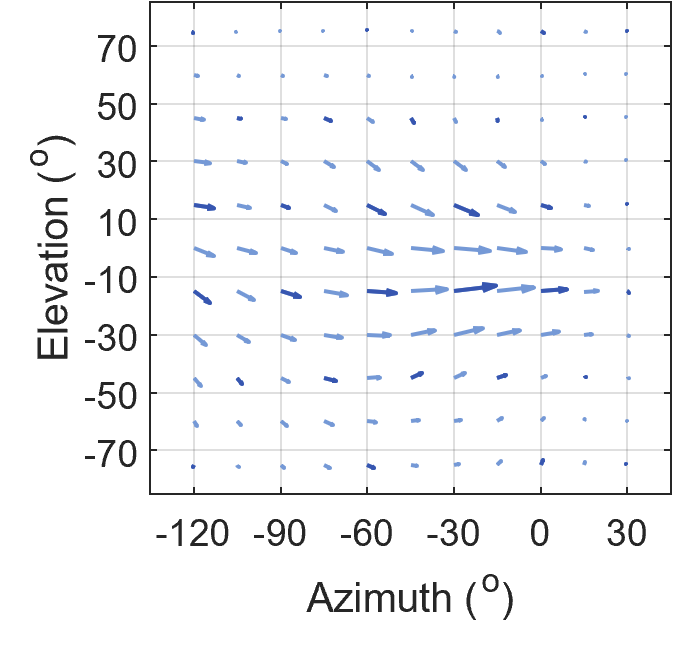
In this paper, we designed a dual DLP projector system (left) to display high-speed patterns with variable angle and degree of polarised light. We used this device in combination with an automated goniometric recording platform (middle) to map the receptive fields of motion-sensitive visual interneurons in the blowfly (H1 cell, right). Receptive field vector magnitudes represent the local motion sensitivty, and directions the local preferred direction, respectively.
Supple et al., (2020) Binocular Encoding in the Damselfly Pre-motor Target Tracking System. Curr. Biol. 30, 645-656.e4. https://doi.org/10.1016/j.cub.2019.12.031
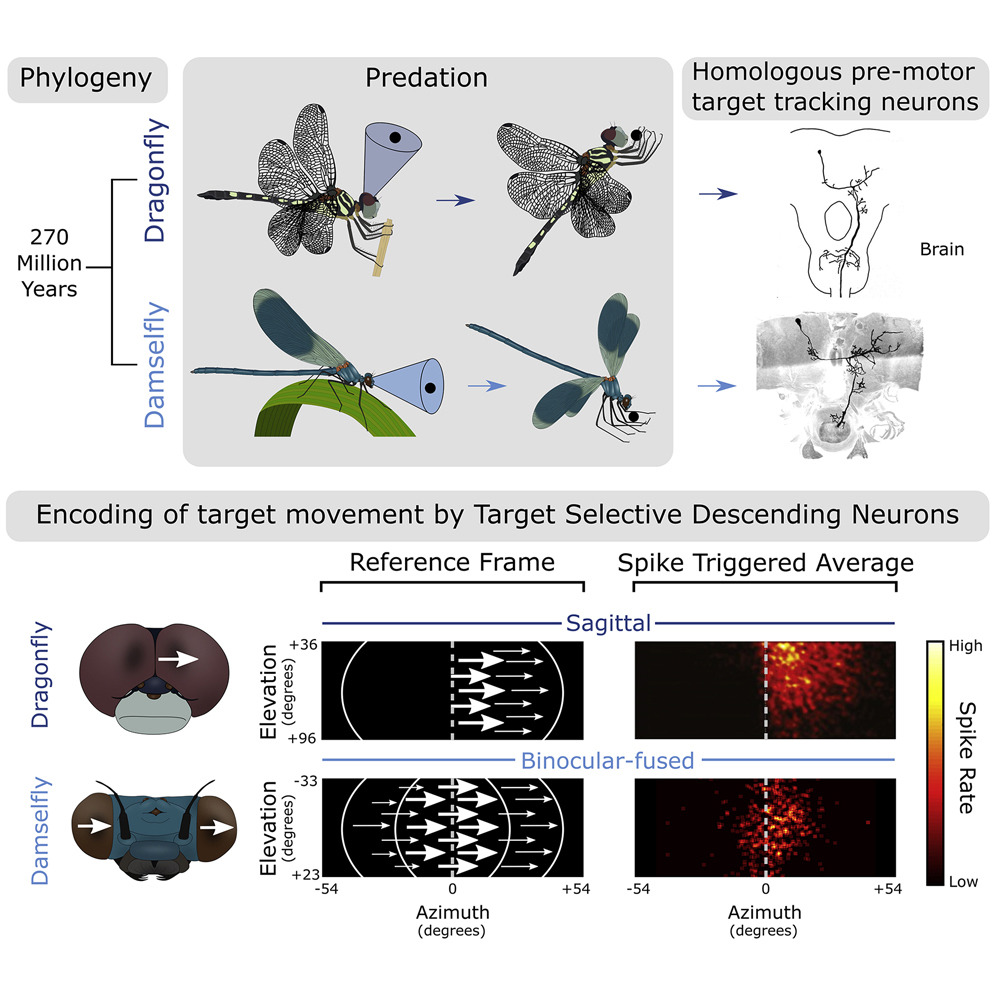
Dragonflies hunt prey from below, whilst damselflies hunt prey head-on. This work demonstrates that a homolgous popuation of target-selective descending neurons (TSDNs) supports these predatory behaviours, with receptive fields shifted dorsally and frontally to align with the visual target location in dragonflies and damselflies, respectively. Through a series of experiments using a miniaturised phoropter, we also demonstrated that damselfly TSDNs integrate binocular information about target movement. This fusion of binocular information in TSDNs, together with the unusually large inter-ocular distances present in damselflies, suggests a role for stereoscopic processing in damselfly predation.

Nicholas†, Supple† et al., (2018). Integration of Small- and Wide-Field Visual Features in Target-Selective Descending Neurons of both Predatory and Nonpredatory Dipterans. J. Neurosci. 38, 10725–10733. †Shared first-authorship https://doi.org/10.1523/JNEUROSCI.1695-18.2018
This study investigated the integration of wide-field optic flow and small-field target movement in dipteran target-selective descending neurons (TSDNs). We discovered that TSDN responses are inhibited when the direction of target motion and wide-dield optic flow are the same. This is interesting as it points to a neuronal separation of target motion arising from the observer’s self-motion, from that due to the target’s motion in the global reference frame. When target movement across the retina matches wide-field optic flow, this suggests that the perceived target movement arises from self-motion. In this condition, TSDNs do not respond, suggesting that TSDNs encode external target movement, i.e. movement across the retina that is not due to one’s own self-motion.
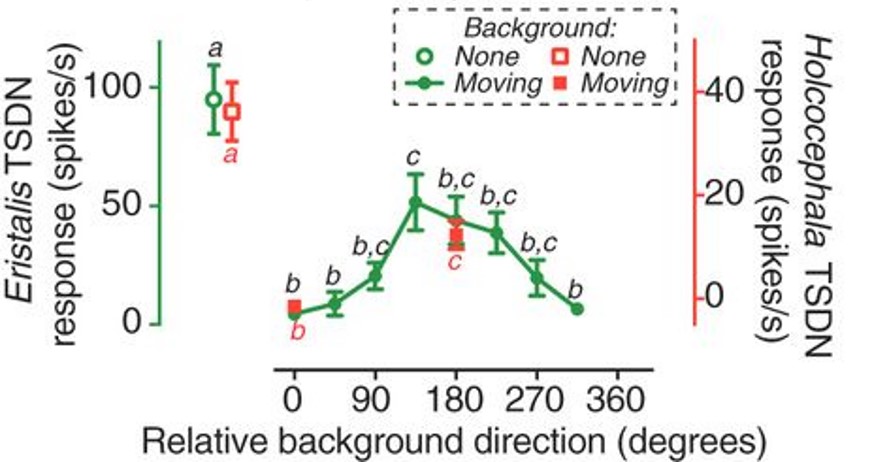
(Left) Target movement matches background wide-field optic flow. (Middle) Target Movement is opposite to background movement. (Right) Dipteran TSDN responses are reduced when the target and background move in the same direction.

